
Nikro Air Duct Cleaning in Oxford Circle: A Homeowner’s Guide
A shop vacuum with a long hose is not duct cleaning equipment. It’s a workaround. Nikro’s negative-air machines are built to hold a measured, sustained airflow through a duct system while the debris gets loosened, and that engineering difference shows up in what actually leaves your ducts. Most homeowners in Oxford Circle have never heard the name Nikro, which is exactly why it’s worth understanding before you book anyone.
Here’s the short version: Nikro equipment is one of the tools our technicians use to clean a whole system rather than skim the surface of it. If you’d rather skip the research and get an answer about your own house, call (833) 498-1334. We answer 24/7. Fast dispatch from 7am to 7pm, Sunday through Friday.
What Do Nikro Negative-Air Machines Actually Do?
A Nikro negative-air machine pulls air out of your duct system at a controlled rate and filters it before releasing it back into the room. That sounds simple, and mechanically it mostly is. What matters is the parts most people never ask about: how much air it moves, how fine its filtration is, and whether it can hold that pull for the duration of the job instead of fading once the filter loads up.
Three things separate this class of machine from a consumer vacuum:
- Airflow measured in cubic feet per minute. Professional negative-air units are rated for sustained CFM, not peak suction at the nozzle. A machine that keeps pulling several hundred CFM through a sealed system creates a pressure differential across the whole duct run, which is what keeps loosened debris moving toward the collection point.
- Multi-stage HEPA filtration. Air that leaves your ducts passes through a pre-filter, then progressively finer stages, ending in HEPA media. That last stage is what stops fine particulate from being exhausted back into the room your family is standing in.
- Containment. Negative pressure means the system is under vacuum while it’s open. Dust goes in, not out. We pair this with Abatement Technologies HEPA equipment on jobs where containment is the priority.
Why does sustained pressure matter so much? Because settled debris in a duct isn’t sitting in the middle of the airway. It clings to the walls, especially where the duct runs cooler and condensation has made the surface tacky. A quick pull grabs what’s already loose. A sustained one keeps the whole system under load while agitation breaks the rest free.
How Nikro Equipment Works With Agitation Tools
Suction alone doesn’t clean a duct wall. That’s the part the equipment catalogues don’t tell you. Negative air removes what’s airborne; something has to physically disturb what’s stuck, which is where agitation tools come in.
A typical job combines three kinds of tool:
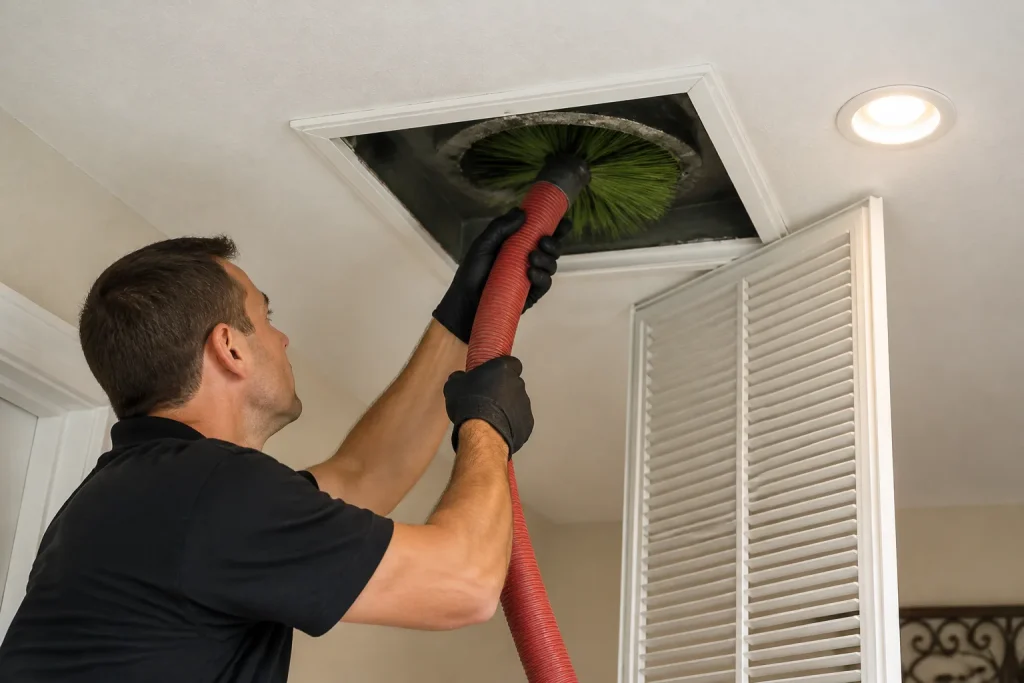
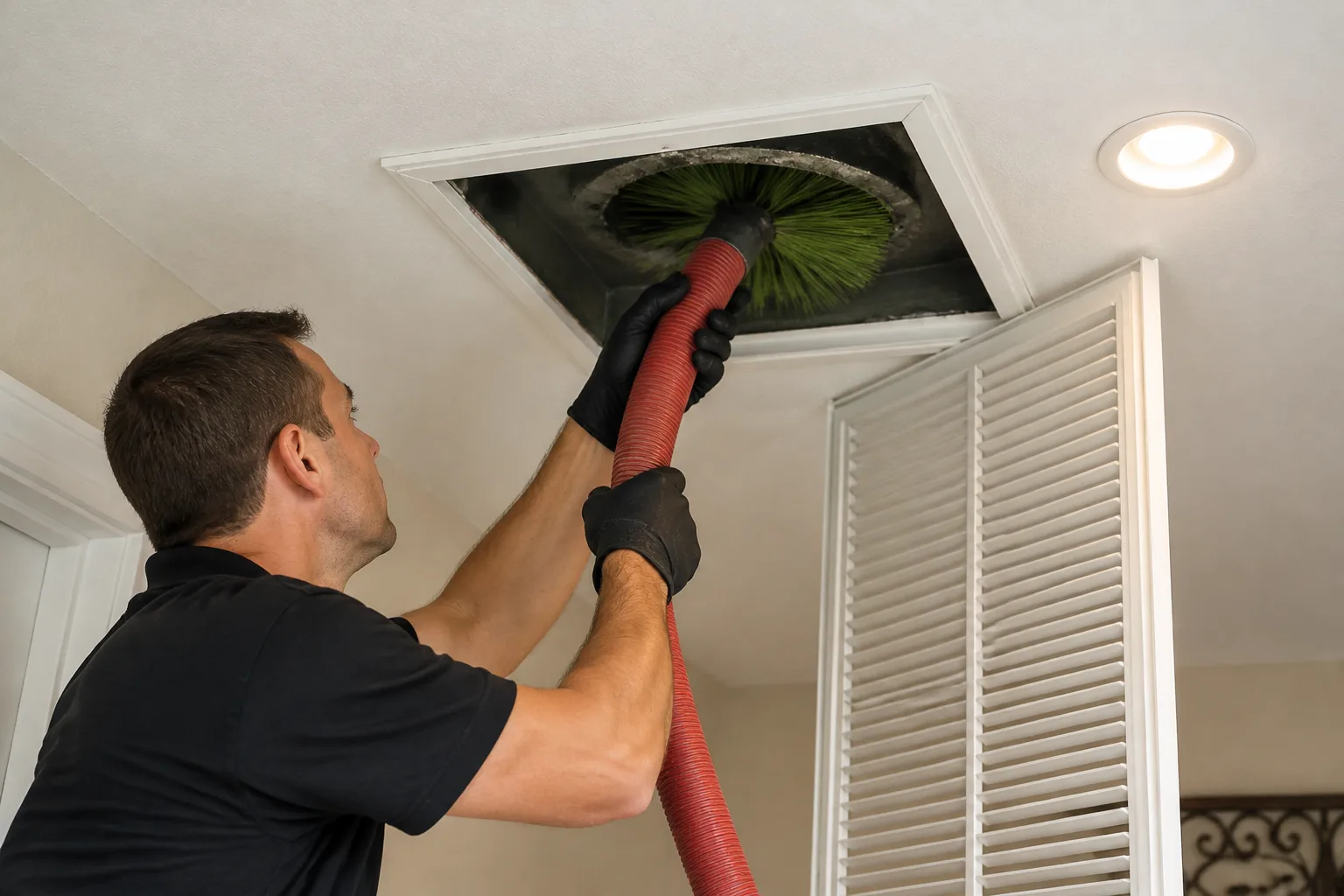
- Rotary whips and brushes. These spin against the inside of the duct and knock debris off the walls. Your Rotobrush system is the workhorse here on residential runs.
- Skipper balls. A compressed-air ball that tumbles through larger duct sections, scuffing surfaces the brush can’t reach at a consistent pressure.
- Compressed-air whips on flexible line. These get into branch runs and tight turns where a rigid brush won’t follow.
The order matters. You agitate a section, let the negative-air machine pull the loosened material out, then move on. Skip the agitation and you’re vacuuming air. Skip the vacuum and you’re pushing dust into the living room. In our experience, the gap between a thorough job and a superficial one comes down almost entirely to whether both halves of that pairing were done properly, in sequence, across the whole system.
Why Most Residential Duct Cleaners Don’t Carry Nikro-Grade Equipment
Cost, training, and transport. A negative-air machine in this class is a serious capital purchase, it requires technicians who know how to set up containment and read airflow, and it takes up real space in a vehicle. A coupon-driven operator running a portable vacuum and a hose doesn’t face any of those barriers, which is part of why the price looks so different on paper.
That’s not a knock on every small operator. It’s a way to read a quote. If the number is dramatically lower than everything else you’ve been offered, something in the process was removed to get there, and it’s usually the equipment or the time spent using it. The honest range for a whole-system clean in a typical Oxford Circle rowhouse reflects a full day or more of setup, agitation, extraction, and inspection. A number far below that range tells you which of those steps is getting skipped.
One more consideration specific to this neighborhood: Oxford Circle’s housing stock is largely older rowhomes and twins, which means duct systems that have been added to, rerouted, or patched over the years. Old flex runs, disconnected joints, and return paths that don’t match the supply side are common. High-airflow equipment reveals those problems because you can hear and feel the leak. A weak vacuum never will, which means you pay for a clean and never learn your system is losing a chunk of its air into a wall cavity.
What a Nikro-Based Cleaning Job Looks Like On-Site
Here’s the sequence, so you know what to expect and what to watch for when a contractor is in your home.
- Walkthrough and system mapping. Every supply and return register gets located and counted, and the contractor confirms where the air handler sits. If nobody counts your vents before quoting, ask why.
- Containment and machine setup. The negative-air unit connects to the main trunk, typically through a purpose-built access opening, and the work area gets covered. You should see HEPA filtration in the setup, not just a hose taped to a register.
- Register-by-register agitation and extraction. Each run is agitated, then evacuated under negative pressure. This is the slow part, and it should be.
- Component cleaning. The blower, coil, and drain pan get attention as part of the system, not as an afterthought. That’s part of our HVAC cleaning scope.
- Inspection and photos. Before-and-after images of your own ducts, not stock photos. Ask for them.
While the work is happening, watch for two things: whether the machine runs continuously rather than in short bursts, and whether the technician checks airflow at the far end of the system. Both tell you the job is being done by pressure and measurement rather than by hope.
Questions to Ask Any Contractor Before You Book
Don’t ask about brand names. A contractor can say “we use professional equipment” about anything with a cord. Ask about specifications instead, because those are harder to fudge.
- “How many CFM does your negative-air machine pull, and is it HEPA filtered?” A real answer comes with a number and a filtration stage count.
- “Do you agitate the duct walls, or just vacuum?” You want to hear about rotary brushes, whips, or skipper balls.
- “Will you show me before-and-after photos of my own system?” If the answer is a brochure, that tells you something.
- “Do you inspect the duct joints and seals?” A cleaned system that leaks still pulls attic or cavity air into your home. That’s why we treat air duct cleaning as a whole-pathway job, sealing included.
- “What’s the flat price for my whole system, agreed before you start?” Not a per-vent rate, not a coupon figure. One number for the system, in writing.
If a contractor can’t answer the first two, the conversation is over. Politely.
When to Call a Pro Instead of Waiting
Some signs mean stop reading and start dialing. Visible dust puffing from a register when the system kicks on. A musty or stale smell that doesn’t leave after you’ve cleaned the house. Allergy symptoms that get worse indoors, or airflow that’s noticeably weaker in the rooms furthest from the air handler. And if you’ve never had the system cleaned since you moved into your Oxford Circle home, a diagnostic visit is the sensible starting point rather than a guess.
One related item worth checking while you’re thinking about air quality: the dryer vent. Lint buildup in a dryer duct is a documented fire risk, and it’s a dedicated service of ours, not an add-on. If you can’t remember the last time yours was cleared, our dryer vent cleaning covers it in the same visit.
Related services in Oxford Circle: Air Duct Cleaning Oxford Circle covers the full picture – cleaning, repair and sealing, air quality and sanitizing, and filtration upgrades with Honeywell and Aprilaire products. One contractor, every part of the system.
The Bottom Line
Nikro equipment matters because of what it lets a technician do, not because of the name on the housing: sustained negative pressure, real HEPA filtration, and enough airflow to work with agitation tools across an entire system. Ask about CFM, filtration stages, and agitation method before you book anyone. Ask for photos of your own ducts afterward. That combination is hard to fake and easy to verify.
If you’re in Oxford Circle and need help, Air Duct Cleaning Oxford Circle offers free estimates. Our technicians have up to 10 years of experience, and you get one flat price per system agreed before work starts. Call (833) 498-1334. We answer 24/7. Fast dispatch from 7am to 7pm, Sunday through Friday.
Frequently Asked Questions
Yes, if the cheaper option is a vacuum-and-hose job. Nikro-class equipment holds negative pressure across the whole system and filters exhaust through HEPA media, which is what actually removes settled debris rather than just the loose surface material. Ask any contractor for their CFM rating and filtration stages; the answer tells you which category they’re in.
Ask for before-and-after photos of your own duct runs, taken during the job, plus a walkthrough at the end where the technician shows you the access points and the condition of the blower and coil. A crew that agitates and extracts properly has nothing to hide in those images.
Because steps were removed to reach that number. Usually it’s the equipment (a consumer-grade vacuum instead of a negative-air machine), the time (a quick pass instead of register-by-register agitation), or the scope (supply only, returns skipped, no sealing inspection). A flat price for the whole system is the number to compare, not a per-vent rate.
Most homes in Oxford Circle do fine on a multi-year interval rather than an annual one, unless you’ve had renovations, water intrusion, a pest issue, or someone in the house with respiratory sensitivity. If you’re seeing dust puff from registers or hearing airflow fade in distant rooms, that’s your cue regardless of the calendar. Call (833) 498-1334 for a free estimate – we’ll tell you honestly whether you need it now or later.
Written by the team at Air Duct Cleaning Oxford Circle.
Need Air Duct Cleaning Help?
Call Air Duct Cleaning Oxford Circle - the local pro we connect you with is licensed and insured, here with fast help in Oxford Circle.
(833) 498-1334